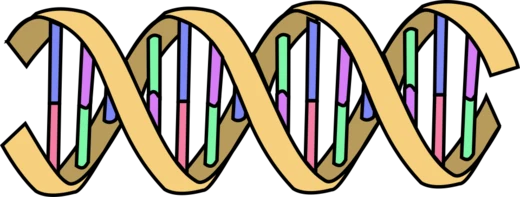
Nucleic acid
Nucleic acids store and transmit genetic information in all life forms.

© OpenStreetMap contributors · CC BY 4.0
Nucleic acids are large biomolecules crucial in all cells and viruses. They are composed of nucleotides, which consist of a 5-carbon sugar, a phosphate group, and a nitrogenous base. The two main classes are deoxyribonucleic acid (DNA) and ribonucleic acid (RNA). Nucleic acids carry information in cells, make up genetic material, and direct protein synthesis. They are found in all living things, encoding and storing information in every living cell, and are also present in viruses.
- key_contributors
- Albrecht Kossel, Phoebus Levene, Astbury and Bell, Avery–MacLeod–McCarty, Watson and Crick
- types
- DNA and RNA
- monomer
- Nucleotide
- sugars
- Ribose (RNA) and deoxyribose (DNA)
- nucleobases
- Adenine, cytosine, guanine, thymine (DNA only), uracil (RNA only)
Lore & Background
Experimental studies of nucleic acids constitute a major part of modern biological and medical research, forming a foundation for genome and forensic science, and the biotechnology and pharmaceutical industries.
Reader's Guide
Nucleic acids are fundamental to all known life, serving as the molecules that encode, store, and express genetic information. DNA and RNA direct protein synthesis, which determines most chemical processes in all life forms. The discovery of nucleic acids and their structure revolutionized biology, leading to modern genetics, genomics, and molecular medicine. The Avery–MacLeod–McCarty experiment established DNA as the carrier of genetic information, and the Watson-Crick double-helix model explained how genetic information is stored and replicated. Today, nucleic acid research underpins genome sequencing, forensic science, and the development of biotechnologies and pharmaceuticals. The ability to synthesize nucleic acids in the laboratory using enzymes or solid-phase chemical synthesis has enabled countless applications, from gene editing to diagnostic tests. Nucleic acids remain a central focus of biological and medical research, with hundreds of millions of nucleotides sequenced daily worldwide.
Did You Know?
- Nucleic acids were named for their initial discovery within the nucleus and for the presence of phosphate groups related to phosphoric acid.
- Thymine occurs only in DNA and uracil only in RNA.
- Some viruses have genomes made of double-stranded RNA, and others have single-stranded DNA genomes.
The Double Helix and Its Landmark Significance
At the Medical Research Council Unit within the Cavendish Laboratory, Francis Crick, James Watson, Rosalind Franklin, and their colleagues articulated a model that transformed nucleic acids from an abstract concept of biological inheritance into a tangible physico-chemical entity. Crucially, this achievement rested on Franklin's prior X-ray crystallography research, which reached Watson and Crick through Maurice Wilkins and Max Perutz. The structure they proposed immediately suggested mechanisms for how DNA replicates itself, opening an entirely new chapter in understanding heredity. The discovery also catalyzed the identification of DNA across microorganisms, plants, and animals, cementing nucleic acids as the universal substrate of genetic information.
Pioneers Who Laid the Groundwork
Long before the double helix was revealed, several scientists chipped away at the mystery of nucleic acids.
An Interdisciplinary Science at the Molecular Scale
Molecular biology occupies a unique position at the crossroads of biochemistry and genetics, drawing on principles from physics, mathematics, and, in more recent decades, computer science through bioinformatics. Its central mission is to decipher the structures and chemical processes that drive biological activity within and between cells, with nucleic acids—DNA and RNA—and proteins serving as its primary subjects. The field examines how these macromolecules are structured, how they function, and how they interact to orchestrate essential processes including replication, transcription, translation, and protein synthesis. Though cells had been observed microscopically as early as the 18th century, a mechanistic understanding of their inner workings only became possible in the 20th century, when advances in physics and chemistry provided the tools necessary to probe biological systems at the molecular level.
From the Laboratory to the Clinic
The practical reach of molecular biology extends well beyond theoretical understanding into the realm of medicine and public health. The techniques developed within this field allow researchers to probe molecular processes with precision, enabling the efficient targeting of new drugs, the diagnosis of disease, and a deeper comprehension of cell physiology. When clinical research and therapeutic interventions arise directly from molecular biology, they fall under the umbrella of gene therapy, while the broader application of molecular biology or molecular cell biology in a medical context is now termed molecular medicine. This translational bridge between fundamental discovery and patient care represents one of the field's most significant contributions.
Gallery


Frequently Asked Questions
What is Nucleic acid?
Nucleic acids are large biomolecules found in every cell and virus, built from repeating units called nucleotides. Each nucleotide pairs a five-carbon sugar with a phosphate group and a nitrogenous base. They exist in two main forms: DNA and RNA.
What is Nucleic acid's role in the cell?
Nucleic acids serve as the information carriers and genetic material of all living organisms. They encode, store, and transmit the instructions needed for protein synthesis and cellular function. In short, they are the molecular blueprint that directs how a cell operates.
Who are the key figures behind Nucleic acid's discovery?
The story spans multiple pioneers, from Albrecht Kossel and Phoebus Levene identifying the chemical building blocks, to the Avery–MacLeod–McCarty group demonstrating DNA's role in heredity. Watson and Crick later revealed the double-helix structure that cemented its place in biology.
What are the two main types of Nucleic acid, and how do they differ?
The two classes are deoxyribonucleic acid (DNA) and ribonucleic acid (RNA). They differ in their sugar—deoxyribose versus ribose—and in one base: DNA uses thymine while RNA uses uracil. Both share adenine, cytosine, and guanine as common nucleobases.
Why is Nucleic acid considered essential to all life?
Nucleic acids are present in every living cell and in viruses, making them universal to biology. Without them, there would be no mechanism to store genetic information or direct protein synthesis. They are the molecular foundation of heredity and cellular function.
More in Cell & Molecular Biology 1-16
Spotted an error? Know more?
This is a living reference — every entry is fact-audited, and reader corrections feed straight into our audit queue. Suggest an edit · See this site's audit record