Ribosome
Cellular machine that synthesizes proteins from mRNA.

Michal H. Kolář · CC BY 4.0
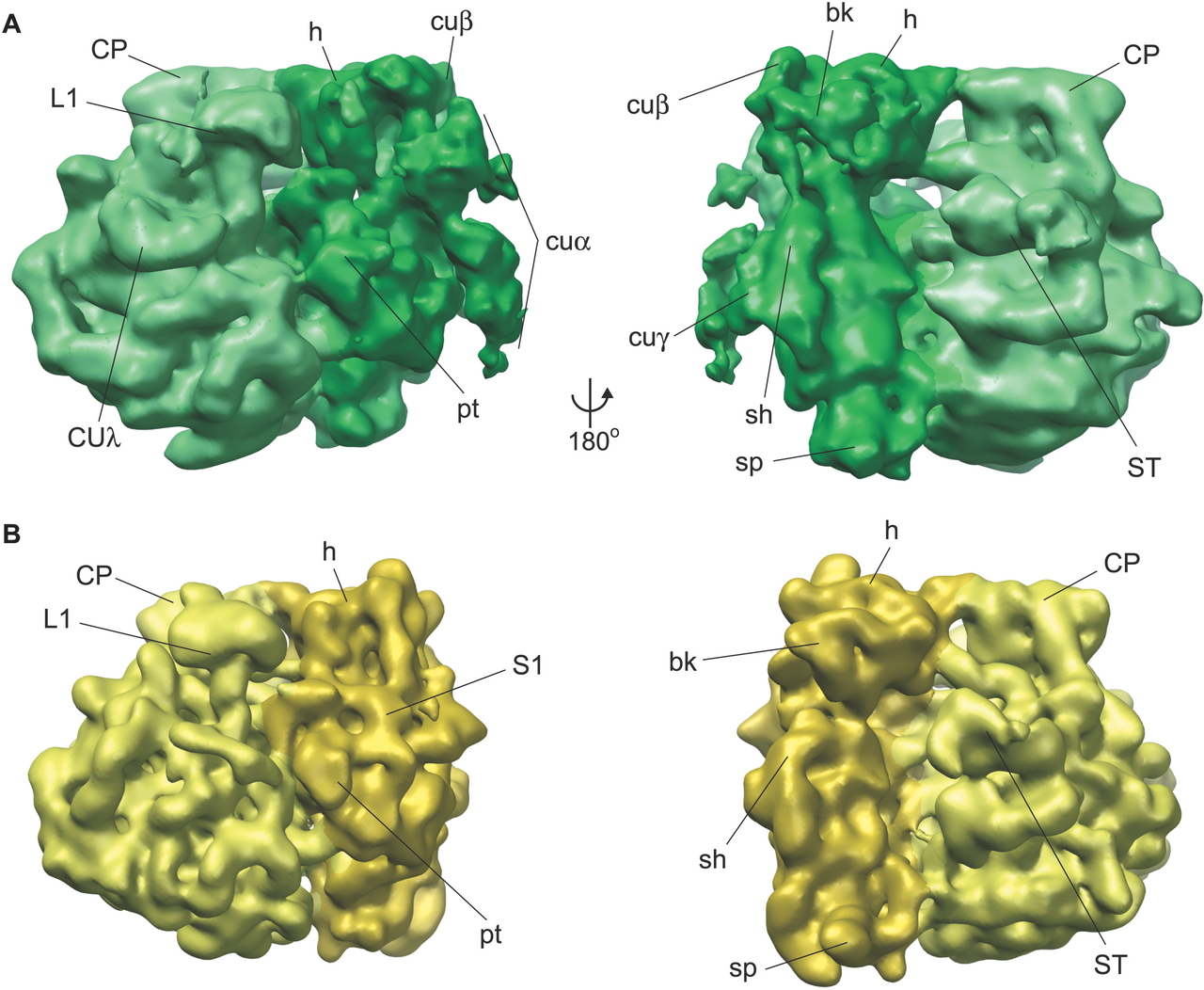
A ribosome is a ribonucleoprotein particle found in all cells that synthesizes proteins by translating genetic information encoded in messenger RNA (mRNA). During translation, the ribosome decodes successive codons in an mRNA molecule and, with the aid of transfer RNA (tRNA), links amino acids into a polypeptide chain. Each ribosome comprises a small and a large subunit, each composed of one or more ribosomal RNA (rRNA) molecules and many ribosomal proteins. Ribosomes are essential for protein synthesis, a fundamental process in all living cells.
- discovered_by
- George Emil Palade
- field
- Cell biology, molecular biology
- type
- Ribonucleoprotein particle
- function
- Protein synthesis (translation)
- known_for
- Translating mRNA into polypeptide chains
Lore & Background
Ribosomes were first observed in the mid-1950s as dense particles or granules by Romanian-American cell biologist George Emil Palade, using an electron microscope. They were initially called Palade granules due to their granular structure. The Nobel Prize in Chemistry 2009 was awarded to Venkatraman Ramakrishnan, Thomas A. Steitz, and Ada E. Yonath for determining the detailed structure and mechanism of the ribosome.
Reader's Guide
Ribosomes are fundamental to all life, as they are the molecular machines that translate genetic information from mRNA into proteins. Ribosomes differ in size and composition among bacteria, archaea, and eukaryotes, but share a core structure reflecting a common evolutionary origin. They are also found in eukaryotic mitochondria and chloroplasts. The catalytic peptidyl transferase activity that links amino acids is performed by ribosomal RNA, making ribosomes a kind of enzyme called ribozymes. Differences in ribosome structure allow some antibiotics to kill bacteria by inhibiting their ribosomes while leaving human ribosomes unaffected. Ribosome biogenesis involves rRNA synthesis and processing together with the assembly of ribosomal proteins into functional subunits.
Did You Know?
- The Nobel Prize in Chemistry 2009 was awarded for determining the atomic structure and mechanism of the ribosome.
- Ribosomes are ribozymes because the catalytic peptidyl transferase activity is performed by ribosomal RNA.
The Ribosome as a Molecular Assembly Line
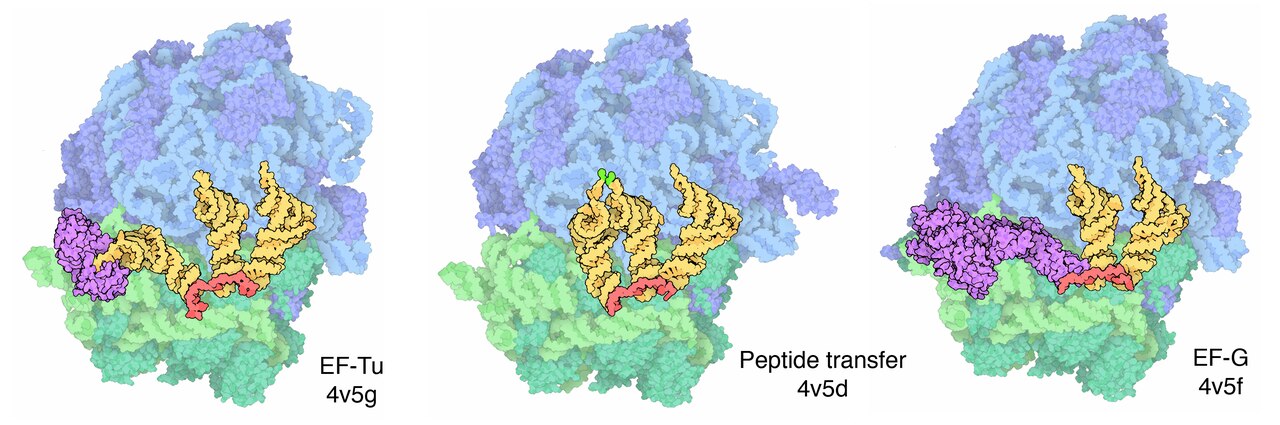
The ribosome functions as the central workshop where amino acids are stitched together into functional proteins. Structurally, it is a multisubunit complex composed of ribosomal RNA and proteins, organized into two distinct subunits. In eukaryotic cells, these are the 40S small subunit and the 60S large subunit, which assemble together before translation begins to create a functional platform. The ribosome maintains two dedicated binding sites for transfer RNA: the aminoacyl site (A) and the peptidyl/exit site (P/E). These sites are oriented along the mRNA in a 5' to 3' order of E-P-A, reflecting the ribosome's directional movement toward the 3' end. At the A-site, an incoming charged tRNA pairs its anticodon with the complementary mRNA codon. A peptide bond then forms, transferring the growing polypeptide chain onto the A-site tRNA. Translocation follows, shifting the now-uncharged tRNA toward the P/E site for release while the polypeptide-bearing tRNA occupies the P/E position, ready for the next cycle. This sequential, one-amino-acid-at-a-time process builds the chain from the amine end toward the carboxyl end.
The tRNA Mediators and the Genetic Code
The translation of genetic information into protein depends on a sophisticated partnership between messenger RNA and transfer RNA molecules. mRNA carries the encoded instructions from the chromosomes to the ribosome, where its ribonucleotide sequence is read in groups of three called codons. Each codon specifies a particular amino acid according to the genetic code. Transfer RNAs, small noncoding chains of 74 to 93 nucleotides, serve as the physical intermediaries. Each tRNA possesses an anticodon region complementary to its corresponding mRNA triplet, along with a site for amino acid attachment. Aminoacyl-tRNA synthetases are the enzymes that catalyze the ester bond linking a specific amino acid's carboxyl group to the 3' hydroxyl of its matching tRNA, producing what is termed a charged tRNA. The diversity of tRNA genes varies enormously across the tree of life, from roughly 20 to 30 in certain bacteria to thousands in complex eukaryotes. When synthetases occasionally pair a tRNA with the wrong amino acid, the resulting mischarged molecule can introduce an incorrect residue into the protein. This mistranslation occurs naturally at low frequencies in most organisms, though particular cellular conditions can elevate it, sometimes to the cell's advantage.
Initiation and the Launch of Protein Synthesis
Before any amino acid can be added, the translation machinery must be assembled at the correct starting point on the mRNA. This initiation phase involves the small ribosomal subunit binding to the 5' end of the messenger RNA, guided by a set of initiation factor proteins. The first tRNA then attaches at the start codon, establishing the reading frame for the entire polypeptide. Two distinct modes of initiation exist. In the more common cap-dependent pathway, the ribosome first recognizes the 5' cap structure and then scans along the mRNA toward the start codon. This cap is added when the nascent pre-mRNA reaches approximately 20 nucleotides in length. In the cap-independent pathway, the ribosome bypasses the 5' cap entirely and engages the mRNA at an internal site. Once the small subunit is positioned and the initiator tRNA is seated, the large subunit joins to form the complete, translationally competent ribosome. The entire process of converting nucleotide information into a functional protein chain is encompassed under the broader term gene expression, and it takes place outside the nucleus, in the cytoplasmic space where the mRNA has been exported from the chromosomes.
Energy Costs and the Pace of Protein Production
Building a protein is an energetically expensive undertaking for the cell. For a polypeptide containing n amino acids, the total number of high-energy phosphate bonds consumed during its synthesis equals 4n minus 1, reflecting the multiple GTP and ATP hydrolysis events that drive each step of the process. After each new amino acid is incorporated and the uncharged tRNA is released into the cytosol, the ribosome must advance one codon toward the 3' end of the mRNA. This translocation step is powered by the hydrolysis of GTP bound to the translocase factor EEF2. The speed at which ribosomes operate differs markedly between domains of life. Prokaryotic cells can add up to 17 to 21 amino acid residues per second, whereas eukaryotic ribosomes manage a more modest 6 to 9 residues per second. The resulting polypeptide does not wait for synthesis to finish before adopting its three-dimensional shape; folding can commence while the chain is still being threaded through the ribosome. Ultimately, the mature protein performs its designated biochemical role within the cell, completing the journey from nucleotide sequence to functional macromolecule.
Gallery
Frequently Asked Questions
Who is Ribosome?
Ribosome is a ribonucleoprotein particle found in every living cell, built from a small and a large subunit that each combine rRNA molecules with numerous ribosomal proteins. It was first identified by George Emil Palade and sits at the heart of cell and molecular biology.
What are Ribosome's powers/role?
Its signature ability is protein synthesis: it reads codons along a messenger RNA strand and, with the help of transfer RNA, links amino acids into a growing polypeptide chain. This decoding-and-assembly process is what biologists call translation.
How does Ribosome's story end?
In the final beat of each round, the ribosome encounters a stop codon on the mRNA, releases the finished polypeptide, and its two subunits fall apart. The freed subunits can then reassemble and kick off another cycle of translation.
Why is Ribosome important?
No cell can manufacture the proteins it needs to survive without this particle, so it underpins every metabolic and structural process in living organisms. Its universal presence across all domains of life makes it one of the most fundamental molecular machines in biology.
What is Ribosome made of?
Each ribosome is a two-part assembly: a smaller subunit and a larger subunit, and every one of those subunits is a complex of one or more ribosomal RNA molecules combined with many ribosomal proteins. That rRNA-plus-protein architecture is exactly what earns it the label 'ribonucleoprotein particle.'
More in Cell & Molecular Biology 1-16
Spotted an error? Know more?
This is a living reference — every entry is fact-audited, and reader corrections feed straight into our audit queue. Suggest an edit · See this site's audit record