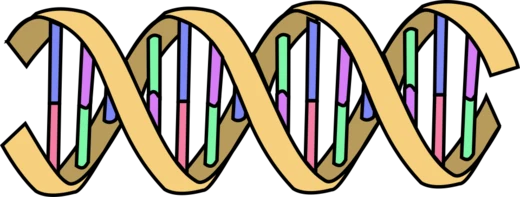
Protein
Proteins are essential macromolecules that perform diverse cellular functions.

Mashaalx · CC BY-SA 4.0
Proteins are large biomolecules and macromolecules composed of one or more long chains of amino acid residues. They perform a vast array of functions within organisms, including catalyzing metabolic reactions, DNA replication, responding to stimuli, providing structure, and transporting molecules. Proteins differ primarily in their amino acid sequence, which is dictated by the nucleotide sequence of their genes and usually results in a specific 3D structure that determines activity.
- field
- Biochemistry, Molecular Biology
- known_for
- Essential biomolecules that catalyze reactions, provide structure, and participate in virtually every cellular process
- first_named_by
- Jöns Jacob Berzelius (1838)
- first_isolated_amino_acid
- Leucine (by Gerardus Johannes Mulder)
Lore & Background
Vegetable proteins studied in the late 1700s and early 1800s included gluten, plant albumin, gliadin, and legumin. The Dutch chemist Gerardus Johannes Mulder, named by the Swedish chemist Jöns Jacob Berzelius in 1838, carried out elemental analysis and found nearly all proteins had the same empirical formula, erroneously concluding they might be a single type of very large molecule. Early nutritional scientists like Carl von Voit believed protein was the most important nutrient for maintaining body structure. Thomas Burr Osborne and Lafayette Mendel established several nutritionally essential amino acids through rat feeding experiments. The final essential amino acid discovered, threonine, was identified by William Cumming Rose. In the 1950s, the Armour Hot Dog Company purified 1 kg of bovine pancreatic ribonuclease A and made it freely available, helping it become a major target for biochemical study. James B. Christian Anfinsen's studies of ribonuclease A folding solidified the thermodynamic hypothesis of protein folding. Cryo-electron microscopy later allowed analysis of larger structures.
Reader's Guide
Proteins are fundamental to life, participating in virtually every cellular process. They catalyze biochemical reactions as enzymes, provide structural support (e.g., actin and myosin in muscle, cytoskeleton scaffolding), and are crucial for cell signaling, immune responses, cell adhesion, and the cell cycle. In animals, dietary proteins provide essential amino acids that cannot be synthesized, and are digested to replenish the body's free amino acid pool for making new proteins and energy production. Proteins are classified primarily by sequence and structure, with enzymes using the EC number system and gene ontology classifying by function and location. Sequence similarity helps classify proteins by evolutionary and functional similarity, often using protein domains. The study of proteins has evolved from early elemental analysis to modern techniques like X-ray crystallography, cryo-electron microscopy, and computational structure prediction. Protein turnover, including degradation by the proteasome, ensures abnormal or misfolded proteins are rapidly removed, with lifespans ranging from minutes to years.
Did You Know?
- Proteins were first named by Jöns Jacob Berzelius in 1838, from the Greek word 'proteios' meaning 'primary.'
- The Armour Hot Dog Company purified 1 kg of bovine pancreatic ribonuclease A in the 1950s and made it freely available to scientists.
The Molecular Stage Where Proteins and Nucleic Acids Take Center Stage
Molecular biology occupies a unique position at the intersection of biochemistry and genetics, united by a shared ambition to uncover the molecular machinery behind vital cellular functions. At its core, the discipline zeroes in on two families of macromolecules—nucleic acids like DNA and RNA, and proteins—and traces how their structures, functions, and mutual interactions drive processes ranging from replication and transcription to translation and protein synthesis. The field is inherently multi-disciplinary, drawing on principles from genetics, biochemistry, physics, mathematics, and, more recently, computer science through bioinformatics. While cells and microscopic structures had been observed since the 18th century, a mechanistic understanding of how they behave only became possible in the 20th century, once technologies from physics and chemistry matured enough to be applied to biological questions.
The Double Helix and the Birth of a Field
This achievement is widely regarded as the landmark that gave the nascent field a physico-chemical foundation for understanding nucleic acids as the primary carriers of biological inheritance—a concept that had previously remained somewhat nebulous. Crucially, the model was built upon earlier X-ray crystallography research conducted by Franklin, which reached Watson and Crick through Maurice Wilkins and Max Perutz. Watson and Crick went further, conjecturing about how the unique geometry of the double helix might explain the mechanism of DNA replication. The work opened the door to discovering DNA in microorganisms, plants, and animals alike.
From Pea Plants to the Genetic Code
His law of segregation—stipulating that diploid organisms carrying two alleles for a gene will transmit only one to their offspring—gave rise to what we now call Mendelian genetics.
From Laboratory Bench to Clinical Practice
Beyond its theoretical contributions, molecular biology has become a powerful engine for practical medicine and drug development. The techniques the field has cultivated allow scientists to target new therapeutics with precision, diagnose disease at the molecular level, and deepen their understanding of cell physiology. Clinical research and medical therapies that flow directly from molecular biology are often grouped under the umbrella of gene therapy, while the broader application of molecular and molecular cell biology in a clinical setting has come to be known as molecular medicine. The discipline's reach is further extended by its multi-disciplinary character: it borrows tools and frameworks from physics, chemistry, mathematics, and increasingly from computer science through bioinformatics, enabling computational approaches to biological questions. Advances in the field have been tightly coupled to the development and optimization of new technologies, meaning that each generation of instrumentation and analytical methods has unlocked new layers of cellular complexity. In this way, molecular biology continues to evolve not as a static body of knowledge but as a living, technology-driven pursuit of the molecular logic underlying life.
Gallery
Frequently Asked Questions
Who is Protein?
Protein is a large macromolecule assembled from one or more long chains of amino acid residues. It was first given its name by Jöns Jacob Berzelius in 1838, and its unique three-dimensional shape—determined by the amino acid sequence encoded in its gene—is what ultimately dictates its activity.
What are Protein's powers and role?
Protein catalyzes metabolic reactions, assists in DNA replication, responds to cellular stimuli, provides structural scaffolding, and transports molecules throughout the cell. In short, it is involved in virtually every process a living cell carries out.
How does Protein's story end?
A protein's functional arc concludes when its carefully folded 3D structure is lost through denaturation or when the molecule is broken down by cellular degradation pathways. Once that precise shape is gone, the amino acid chain can no longer carry out its designated role.
Why is Protein so important to the canon?
Proteins are the essential biomolecules that drive catalysis, structural integrity, and signaling in all known organisms. Without them, cells could not replicate genetic material, maintain their shape, or react to their surroundings.
Who first isolated an amino acid, and why does that matter?
Gerardus Johannes Mulder was the first to isolate an amino acid, specifically leucine. That milestone helped establish that proteins are built from discrete amino acid building blocks, a foundational idea in biochemistry and molecular biology.
More in Cell & Molecular Biology 1-16
Spotted an error? Know more?
This is a living reference — every entry is fact-audited, and reader corrections feed straight into our audit queue. Suggest an edit · See this site's audit record